
Age spots can creep up on you. You might notice a small brown mark on the back of your hand, a darker patch on your cheek or a few new spots across your shoulders.
They’re particularly common as we get older, although age isn’t the only reason they appear.
Years of sun exposure can leave visible changes in the skin, including darker patches. Most genuine age spots are harmless, but it’s worth knowing what you’re looking at before considering any cosmetic treatment.
At LA LIPO, we provide cosmetic skin treatments in the comfort of your own home for certain skin lesions that have already been confirmed as harmless. If you’ve noticed age spots appearing, you might be wondering what’s causing them and whether anything can be done. We’ll explain what you need to know, including how to recognise different types of skin marks and when it’s worth getting them checked.
What Are Age Spots?
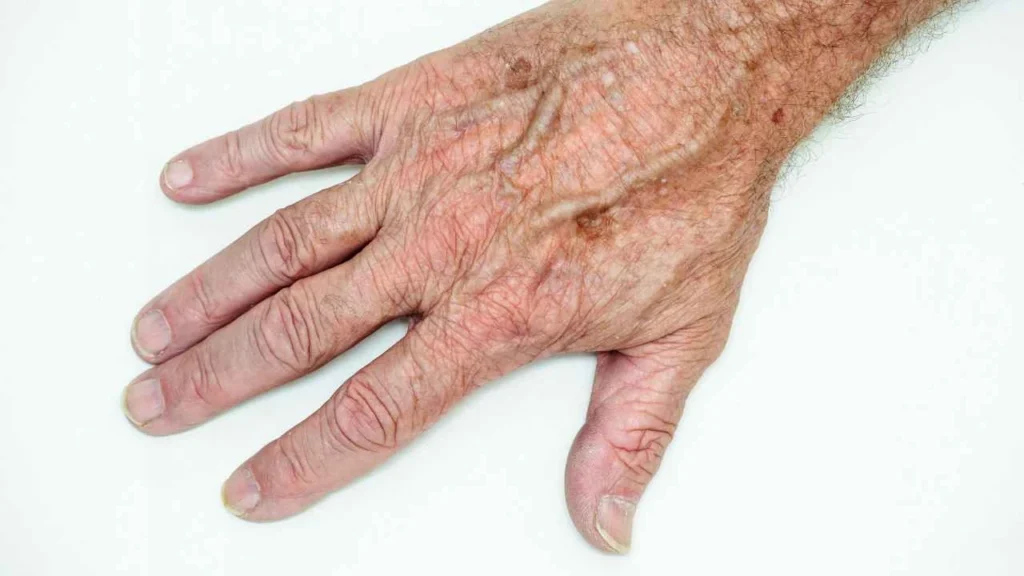
Age spots are flat areas of darker pigmentation that usually develop on skin regularly exposed to sunlight.
You may also hear them called:
- Sun spots
- Liver spots
- Solar lentigines
Despite the name, liver spots have nothing to do with liver health.
They can vary in size and colour, from light brown to much darker shades. Common locations include the face, hands, arms, shoulders and upper chest.
Unlike freckles, which may become less noticeable in winter, age spots often remain visible year-round.
Although confirmed solar lentigines are benign, other skin conditions can look similar. A brown patch shouldn’t automatically be assumed to be an age spot.
Why Do Age Spots Develop?
Years of sun exposure
The biggest contributing factor is accumulated ultraviolet (UV) exposure.
Your skin produces melanin, the pigment that gives it colour. UV exposure can affect how melanin is produced and distributed, leaving some areas looking darker than the surrounding skin.
These changes don’t necessarily appear straight away. A mark you notice in your fifties may be associated with sun exposure from many years earlier.
Natural ageing
Age spots become more common as we get older, partly because our skin has experienced more years of sunlight.
Changes in the skin over time can also make pigmentation differences more noticeable.
Skin type and genetics
Some people develop age spots more readily than others.
People with lighter skin and a history of significant sun exposure may be more likely to develop solar lentigines. However, pigmentation changes can occur across different skin tones.
Sunbeds and artificial UV exposure
Sunbeds expose the skin to ultraviolet radiation and can contribute to skin damage and pigmentation changes.
Avoiding sunbeds helps reduce unnecessary UV exposure.
Are Age Spots the Same as Skin Growths?
Not necessarily, and this distinction matters.
An age spot is usually flat. A raised, rough or waxy-looking area might be a different type of skin lesion altogether.
For example, seborrheic keratoses are common benign growths that can become more noticeable with age. They often have a slightly raised, textured appearance.
Another condition, actinic keratosis, may appear as a rough or scaly patch on sun-damaged skin. This is different from an ordinary age spot and requires medical assessment because some lesions can progress to skin cancer.
Some skin cancers can also resemble harmless pigmented marks.
If you’re unsure what a patch or growth is, your GP should assess it before you consider cosmetic removal.
When Should You Get an Age Spot Checked?
It’s sensible to keep an eye on your skin, particularly areas that receive plenty of sunlight.
Arrange a GP appointment if you notice a mark that:
- Changes in size, shape or colour
- Develops an irregular outline
- Starts bleeding or crusting
- Becomes painful or persistently itchy
- Looks noticeably different from other marks on your skin
- Develops into a new or growing lump
A new or changing lesion shouldn’t be treated cosmetically until it has been appropriately assessed.
LA LIPO does not diagnose skin cancer or offer cosmetic freezing as a substitute for medical investigation.
Can Age Spots Be Removed?
Some people are happy to leave age spots alone, particularly once they’ve been confirmed as harmless.
Others consider cosmetic treatment because they dislike the appearance of darker patches.
Several approaches exist, depending on the type of pigmentation, its location, and your skin.
Skincare and sun protection
Daily sun protection is an important part of looking after sun-exposed skin.
Certain topical skincare ingredients may also help improve the appearance of uneven pigmentation, although results vary and established age spots may remain visible.
Professional skin treatments
Depending on the diagnosis, options may include laser treatments, certain chemical peels or cryotherapy.
Not every treatment suits every skin type or lesion.
Weigh potential benefits against risks such as irritation, pigmentation changes, and scarring.
How Does Cryotherapy Work for Age Spots?
Cryotherapy uses controlled freezing to treat certain skin lesions.
When a suitable, confirmed benign lesion is treated, freezing damages the targeted tissue. Over time, the treated area may blister, crust or shed as the skin heals.
CryoPen is one type of device used to deliver targeted cryotherapy.
At LA LIPO, CryoPen treatment may be considered for selected benign lesions, subject to the practitioner’s assessment and confirmation that cosmetic treatment is appropriate.
Not all pigmented patches can or should be treated this way.
Importantly, freezing an undiagnosed lesion can delay identifying a more serious skin condition. This is why medical assessment must come before cosmetic treatment whenever the diagnosis is uncertain.
What Happens After Cryotherapy?
Your skin needs time to respond to freezing.
The treated area may feel tender or look red and swollen shortly afterwards. Some people develop a blister, followed by a scab as the skin heals.
The area’s appearance can change during recovery, and healing time depends on the location, treatment depth, and individual skin response.
Cryotherapy also carries risks, including infection, delayed healing, scarring and lighter or darker patches of skin. Pigmentation changes can sometimes be permanent.
These risks may be particularly noticeable in darker skin tones or in people prone to pigmentation changes.
Your practitioner should explain the possible complications, provide aftercare instructions and tell you when to seek medical advice.
Complete removal isn’t guaranteed, and some lesions may remain or return.
Can You Prevent Age Spots From Appearing?

You can’t undo every effect of past sun exposure, but protecting your skin now can help reduce further UV damage.
Looking after your skin doesn’t need to be complicated.
- A good place to start is getting into the habit of wearing a broad-spectrum SPF 30 or higher sunscreen, even on days when it doesn’t feel particularly sunny.
- Remember to reapply throughout the day, especially if you’re spending time outside.
- Avoid sunbeds.
- Check your skin regularly for new or changing marks.
Even after cosmetic treatment, age spots can develop further.
Sun protection helps reduce future UV damage, but it cannot guarantee that pigmentation won’t return.
Considering Age Spot Treatment at Home With LA LIPO?
LA LIPO offers selected mobile cosmetic treatments in customers’ homes across available UK service areas.
If you’ve already had a skin lesion diagnosed as benign and are considering cosmetic removal, our team can explain the available treatments and what we’ll need to know before an appointment.
Your practitioner will need to consider the lesion, its location, your medical history and any factors that could make treatment unsuitable.
If a mark hasn’t been diagnosed or there are concerns about its appearance, medical assessment should come first.
Contact LA LIPO
Ask our team about mobile CryoPen appointments, treatment suitability and availability in your area.
Age Spots FAQs
1. Why do age spots appear on the skin?
Age spots are usually linked to years of sun exposure. Each time your skin is exposed to UV rays, it can affect pigment production. Over time, this can leave darker patches, particularly on areas such as your face, hands, and shoulders. You might not notice them until later in life, even though the changes have been developing for quite some time.
2. Are age spots cancerous?
Genuine solar lentigines are benign. However, some skin cancers and other conditions can resemble age spots. A new, changing or unusual mark should be assessed by a GP rather than assumed harmless.
3. Can age spots become raised?
Typical age spots are flat. If a mark becomes raised or develops a rough surface, it may be another type of lesion. Have it checked, especially if it has changed in appearance.
4. What’s the difference between an age spot and seborrhoeic keratosis?
Age spots are generally flat areas of pigmentation. Seborrhoeic keratoses are benign growths that often look raised, waxy or textured. Their appearance can overlap, so medical assessment may be needed to establish what a lesion is.
5. Can CryoPen remove age spots?
CryoPen cryotherapy may be used for selected, confirmed benign pigmented lesions. Suitability depends on the diagnosis, location and individual skin characteristics. Complete clearance cannot be promised.
6. Does cryotherapy hurt?
You may experience stinging, discomfort or a cold sensation during freezing. The area can also feel tender afterwards. Discomfort varies by person and treatment site.
7. How long will my skin take to heal after having an age spot frozen?
You may notice some redness or tenderness after treatment, and it’s quite common for a small blister or scab to form. This is part of the skin’s response to freezing. Some areas heal more quickly than others, but it can take several weeks for the skin to settle. You might also notice that the treated area looks lighter or darker than the surrounding skin. These colour changes can take much longer to fade and, in some cases, may be permanent.
8. Will age spots come back after treatment?
They can. Freezing doesn’t always remove an age spot completely, and occasionally a treated mark may reappear. You may also develop new age spots, particularly on areas of skin that regularly see the sun. Wearing sunscreen and protecting your skin from UV exposure can help reduce further sun damage, although it won’t necessarily stop new spots from appearing.
9. Is cryotherapy suitable for darker skin tones?
It may be considered in some circumstances, but there is a risk of noticeable lightening or darkening of the treated skin. These changes can be permanent. Your practitioner should discuss the risks and possible alternatives before proceeding.
10. Can I have age spots removed on my face?
Some facial lesions may be suitable for treatment, but facial skin and areas near the eyes require particular care. Suitability depends on the diagnosis, location and treatment method.
11. Can I treat an age spot myself?
Avoid attempting to freeze, burn or remove an unidentified pigmented lesion at home. This can damage the skin and may delay the diagnosis of a potentially serious condition.
12. Do I need to have my age spots removed?
Not necessarily. If a doctor has confirmed that the marks are harmless, there’s usually no medical reason to remove them. Some people aren’t bothered by age spots, while others would prefer to have them treated because of how they look. It’s entirely up to you. However, if a mark starts changing in size, shape, or colour, it’s important to have your GP check it.
Important information: This article provides general information about age spots and cosmetic treatment. It does not replace medical advice or diagnosis. New, changing, bleeding, irregular, or otherwise suspicious pigmented lesions require appropriate medical assessment before considering cosmetic treatment. Cryotherapy carries risks including blistering, infection, scarring and potentially permanent changes in skin pigmentation. Results vary, and complete removal cannot be guaranteed.
For further information, please call us on 03300 100 238